
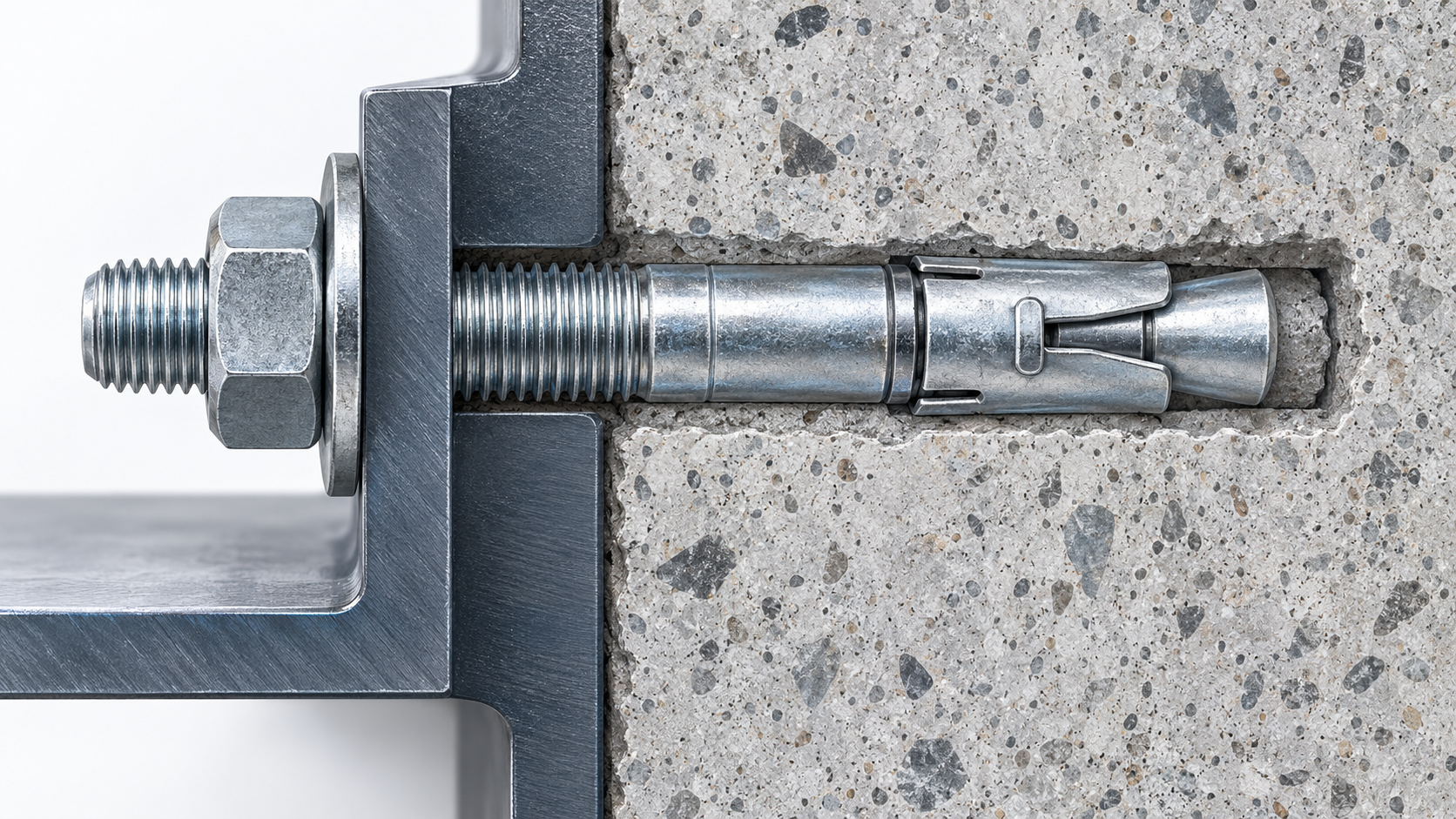
Start with the project, not the catalogue name
“Wedge anchor” identifies a mechanical expansion anchor family. It does not, by itself, establish the correct diameter, length, steel grade, coating, clip design, required embedment, drill diameter, supplied components or technical evidence. For a distributor, brand owner or project buyer, those gaps are where apparently similar offers become difficult to compare.
A useful purchase decision connects the product to a real installation. The buyer should know what is being fixed, the base-material condition named in the project requirement, the available installation access, the intended service environment and the documents the customer or engineer expects. The manufacturer can then quote an identifiable configuration rather than a broad family name.
This guide is for commercial sourcing and product-range planning. It does not replace the applicable project specification, local code or the installation and design information issued for the exact anchor proposed.
Build a wedge anchor purchasing brief
The strongest RFQ tells every supplier the same story. It states which information is fixed, which is preferred and which can be reviewed as a value-engineering option. That makes quotations more transparent and reduces late changes between sample approval and production.
1. Define the use case and market
- What will be fixed: steel bracket, machine base, racking component, guardrail support, façade element or another fixture.
- Where it will be used: indoor dry service, humid location, exterior exposure, industrial environment or another named condition.
- The destination country or project market, plus the required product evidence or approval route.
- Whether the item is a distributor stock line, a private-label product or a project-specific purchase.
- The expected launch quantity, repeat-order plan and required delivery date.
2. Define the product configuration
Give the manufacturer a drawing, an approved sample or a controlled reference. Then record the requested diameter and length range, thread system, supplied nut and washer, clip configuration, material or coating request, marking, installation instructions and packaging format. If a requirement is unknown, mark it as open rather than allowing each supplier to assume differently.
For a full range, use a line-by-line schedule. A list such as “M8 × 75, M10 × 90, M12 × 120” is clearer when it also identifies the required component set, carton quantity and finish for each line. It lets the factory check material routing, pack-out and labelling before it prices the order.
Understand what must stay matched
A wedge anchor develops its fixing action through mechanical expansion in a drilled hole. The stud, expansion clip, cone geometry, substrate, hole preparation, installation depth and tightening process are part of one system. A change to one of those elements can affect installation behaviour and should be reviewed against the documentation for the exact proposed product.
That is why a responsible supplier conversation separates visual similarity from documented equivalence. For example, a proposed alternate may share a nominal diameter but have a different sleeve or clip, thread length, supplied washer, coating process or installation data. It may be a suitable commercial option, but it should be presented as a controlled alternative with the differences made visible.
Ask these installation questions before ordering
- What base material and concrete condition are specified for the intended application?
- What fixture thickness and installation access must the anchor accommodate?
- Which drill diameter, cleaning procedure, embedment and tightening instructions apply to the proposed model?
- Are the nut and washer supplied, and are they packed with each anchor or separately?
- Which instructions, drawing, test reports or approval documents are required by the buyer or end user?
For a related comparison, see Concrete Screw vs Wedge Anchor: A Practical Buying Guide. It explains why a screw anchor and an expansion anchor should not be treated as automatic substitutes.
Specify material and corrosion protection precisely
“Galvanized” and “stainless” are useful starting descriptions, but they are not complete procurement specifications. A clear RFQ identifies the requested anchor material or grade, the finish or coating system, the components that must receive the same protection and the service environment that drove the request.
Also ask what is included in the description. The anchor body, clip, nut and washer may all be relevant to the required supply configuration. A quotation should not leave the receiving team to discover that a part was excluded, substituted or packed separately.
Make the comparison sheet show
- Requested material or coating terminology for the complete supplied set.
- Any requirement for stainless components, galvanizing, zinc plating or another stated finish.
- Coating appearance expectations, handling protection and any inspection records requested.
- The environment described by the buyer or project; do not infer exposure conditions from product photographs.
- Any customer requirement for traceability, certificate scope or batch identification.
Read Stainless Steel vs Galvanized Wedge Anchors: What to Specify before comparing offers across different finishes. It gives a practical way to turn a material question into an RFQ field.
Move from sample to approved production baseline
A sample is more useful when it represents an agreed revision rather than a general example. The sample stage should validate the commercial configuration as well as basic appearance: the selected size, component set, finish, labels, carton method and any documents that will accompany production.
For a private-label or distributor order, start by assigning a reference to every approved size. Photograph critical details, retain a representative sample where practical and put the agreed information into a revision-controlled specification. This gives both the buyer and the factory a stable point of reference when a repeat order is placed months later.
A practical approval pack
- Product schedule with size, thread system, length, components and finish.
- Drawing, sample record or controlled product description for each item.
- Packaging and labelling artwork, carton quantity and barcode requirements.
- Required product documents and the exact configuration they cover.
- Inspection points, acceptance limits and any approved deviations.
- Named contacts who can approve a technical or commercial change.
Do not treat silence as approval. Close every sample review with a short record of accepted items, outstanding questions and the next revision. The production release should identify which approved version is controlling.
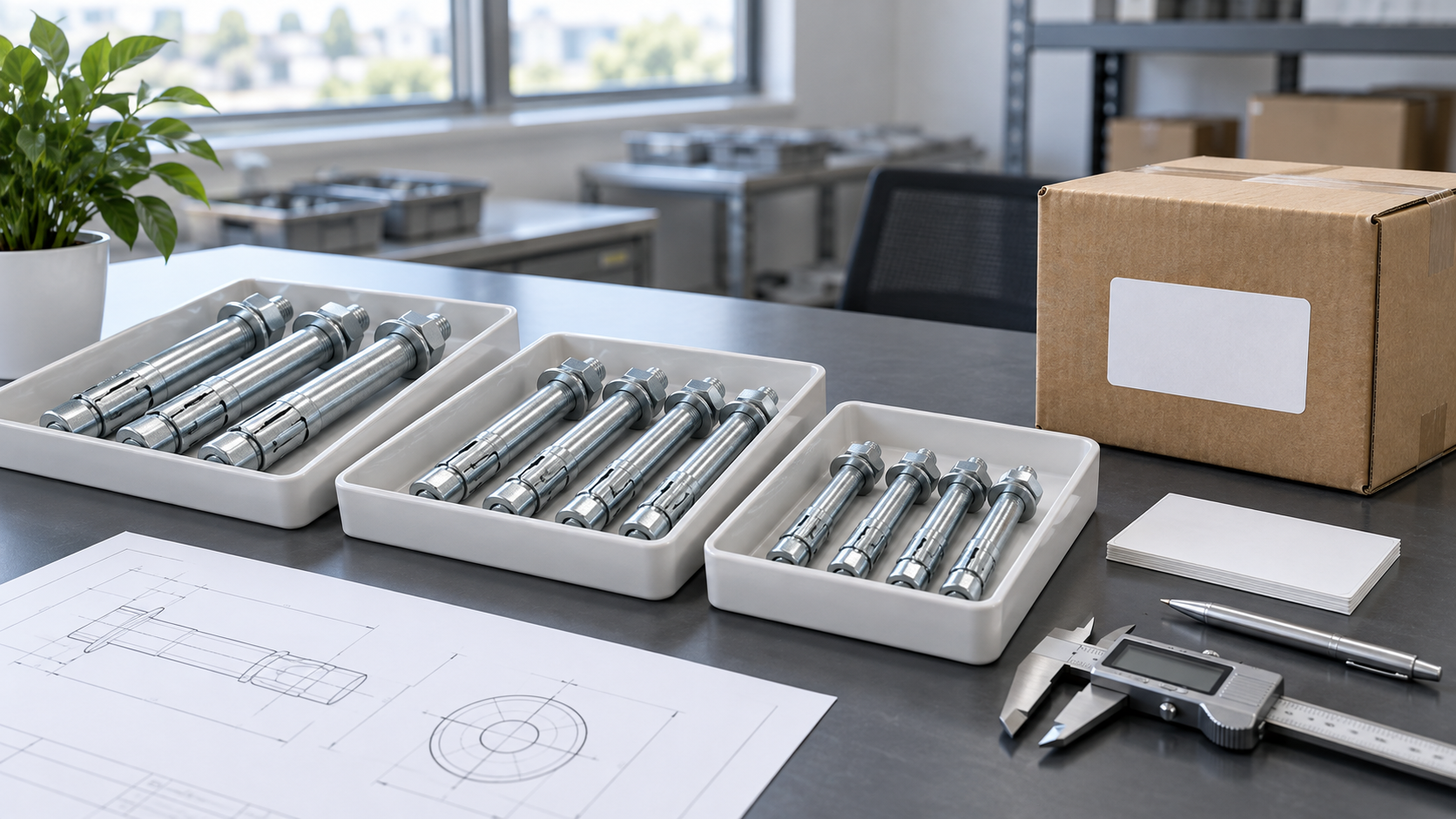
Compare the full landed supply package
Low unit pricing is only meaningful when the offers describe the same package. Before selecting a supplier, compare the goods, packing, documents, sample charges, production quantity, trade term and delivery assumption side by side. If one quotation omits a required nut, uses a different carton quantity or excludes private-label packaging, show it as a difference rather than averaging it into the unit price.
Separate one-time and recurring costs
One-time costs can include sample preparation, special pack artwork, printing setup, testing, tooling or other project-specific work. Recurring costs cover the manufactured anchors and the agreed repeated services such as standard labelling, cartons, inspection or documentation. Separating these items helps a buyer understand both the launch order and the economics of replenishment.
Make lead-time triggers explicit
“Lead time” may mean different things to different people. Record separate expectations for sample preparation, approval, packaging-file release, material preparation, production and shipment readiness. Note the event that starts each period, such as drawing approval, deposit, approval of a pre-production sample or receipt of final label artwork.
Plan quality checks and change control before production
Quality control is strongest when it follows the approved product definition. The control plan should say what will be checked, who records the result and what happens if the delivered item differs from the agreed requirement. For stock programs, it should also ensure the carton label and the product inside remain connected to the correct size and batch.
Useful pre-shipment checks for a commercial order
- Confirm the product designation, diameter, length, thread and supplied component set against the order schedule.
- Check finish appearance and packing protection against the approved sample or reference.
- Review carton count, labels, barcodes and mixed-size separation.
- Confirm the requested documents are associated with the proposed item, not merely a general product family.
- Record any nonconformity, its disposition and the implementation batch for a corrective change.
If material availability, packaging constraints or production findings require a change, ask the supplier to set out the current and proposed configuration, reason, visual or functional effect, commercial impact and approval needed. A controlled change protects both parties far better than a quiet substitution.
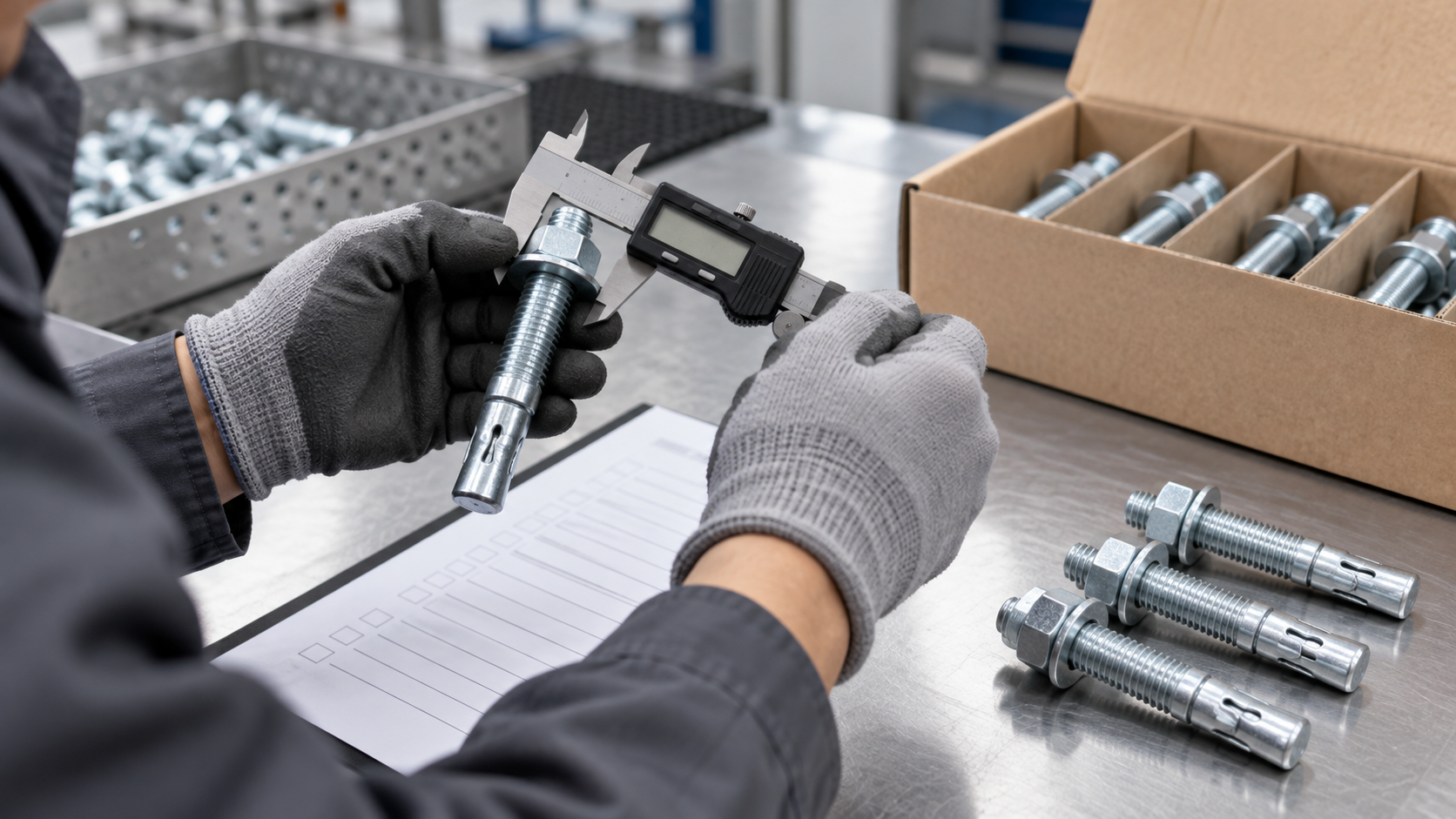
Set up OEM and private-label requirements early
OEM work can range from a standard anchor in branded cartons to a custom range with specified sizes, pack quantities, artwork and documentation. The buyer should describe which elements are controlled: brand name, artwork, label language, barcodes, carton layout, pack-out, sampling, confidentiality and permission to reuse the format for other customers.
For a new private-label range, keep a master specification that links every SKU to its artwork version and approved product configuration. For repeat orders, compare the new purchase order against that master before scheduling production. This process reduces avoidable errors such as an old carton, incorrect quantity per box or a product revision paired with a previous label.
Wedge anchor RFQ checklist
Send the following information when requesting a quotation from DURANCHOR or another supplier:
- Product family and intended application.
- Size schedule: diameter, length, thread and requested range.
- Quantity by SKU and expected repeat-order pattern.
- Material or finish request and service environment description.
- Required nut, washer, clip and other components.
- Destination market plus required product documents or test evidence.
- Packaging, labels, barcode, private-label and carton-count requirements.
- Sample request, inspection plan, target timing and Incoterm or shipping assumption.
When the project has a drawing or specification, attach it. When it does not, share reference photos and clearly state which visual or dimensional points are non-negotiable. The supplier can then identify missing information before issuing a quotation.
Frequently asked questions
Can I compare wedge anchors by diameter and length only?
No. Diameter and length are necessary fields, but they do not define the complete supplied configuration, material or coating, components, installation requirements and product evidence.
How should I compare wedge anchor samples from two suppliers?
Give both suppliers the same controlled brief. Compare the complete proposed item, supplied components, finish, marking, packaging, documents and stated installation information. Record differences before approving a production baseline.
Can DURANCHOR support private-label wedge anchor packaging?
Share the artwork, target pack quantity, barcode, label language, destination market and estimated order quantity. The team can review the requested configuration and identify the information needed for quotation and sample planning.
What should I include in a repeat order?
Reference the approved SKU schedule, product revision, finish, component set, carton quantity, label artwork and quantity by size. Record any requested change separately so it can be reviewed before production.
FROM RFQ TO REPEAT SUPPLY
Discuss your wedge anchor requirement
Send your size schedule, intended application, finish, pack quantity and destination market. DURANCHOR can review the supply configuration and confirm the information needed for a clear quotation.
Send an enquiry →