
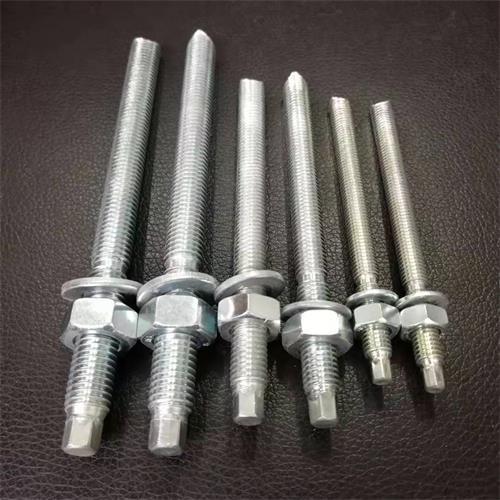
Define the bonded-anchor system, not only the stud
A chemical anchor stud is used with a compatible adhesive system in a drilled hole. The fixing action is based on bonding rather than a mechanical expansion mechanism. For procurement, this means the stud, adhesive or capsule, substrate, hole preparation, installation sequence, curing conditions and intended use must be considered together. Ordering a threaded component without naming the adhesive system leaves a critical part of the application undefined.
DURANCHOR’s Chemical Anchor Stud is listed in carbon-steel and stainless-steel options, with stated diameter and length ranges and finishes including zinc-plated, hot-dip galvanized and Dacromet-coated options. The product page describes use in concrete, masonry, solid brick wall and stone substrates. The final application must be checked against the specific system data and the project requirement.
Retrofit and reinforcement scenarios need clear boundaries
Steel brackets and secondary steelwork
Retrofit work may require a stud to connect a bracket, plate or other steel component to an existing base. The commercial RFQ should include the fixture drawing, stud size, proposed adhesive system, substrate description, edge or spacing constraints stated by the project, and the required installation documentation. The supplier can then identify the requested product configuration without turning a general catalogue statement into an unsupported engineering claim.
Rebar connection and construction reinforcement
The product page describes chemical anchor studs as one route used to connect or reinforce steel bar and threaded rod in concrete construction. For this kind of work, the project designer or responsible technical party should identify the required system, bar or stud detail, substrate condition and relevant approval documentation. A purchasing team should preserve those requirements in the RFQ rather than asking the supplier to infer them from a site photograph.
Near-edge and restricted-space installation
Chemical fixing systems are often considered where an expansion-free route is required. That does not create a universal answer for every edge distance, substrate condition or load case. It is a reason to describe the constraint early and require product-specific review. Mark any non-negotiable installation detail in the request so the quotation does not conceal an assumption that must be resolved later.
Specify material, finish and exposure environment
Choose the stud material and finish from the actual service environment and project specification. The DURANCHOR page lists carbon steel and stainless steel, with zinc plating, yellow zinc plating, hot-dip galvanizing and Dacromet coating among the options described. A request for “corrosion resistant” should be converted into a clear environmental description and a stated material or coating requirement.
State whether the anchor is used in a dry interior area, a humid location, exterior exposure or a location with a named contaminant. Also identify whether the nut and washer are part of the required supply set. This helps the supplier quote a coherent configuration and lets the buyer compare offers on the same basis.
Keep terminology controlled
- Product form: stud, threaded rod or stated head configuration.
- Material and finish required for the complete supplied set.
- Diameter, length and thread standard for every SKU.
- Adhesive product or capsule system the order is designed to work with.
- Substrate and application detail provided by the project.
- Required documents for the exact system and destination market.
Plan installation and sample approval before bulk supply
Installation has a direct effect on whether a chemical fixing system performs as intended. The relevant product and adhesive documentation should state the required drilled-hole preparation, cleaning, injection or capsule procedure, insertion process and curing conditions. Procurement should make sure those instructions can reach the installer in the right language and revision, especially where the order is intended for distribution or a mixed-market program.
For a first order, approve a representative sample configuration. The approval pack should connect the selected stud, nut and washer, finish, adhesive system, carton label and supporting documents. Photograph critical components and record the revision of the instructions. This gives the buyer an auditable baseline when the project moves from sample to bulk supply.
What a controlled change looks like
If the supplier suggests another finish, stud length, adhesive, label or package, ask for the proposal in writing. It should state the current and proposed configuration, reason, document effect, commercial effect and whether new samples or approval records are required. This process prevents a change in one component from silently changing the overall system being supplied.
Use documentation as part of the commercial comparison
A low line-item price cannot resolve an incomplete application record. In addition to the product schedule, ask what data sheet, technical drawing, material declaration, installation instructions and available test or certificate references can be supplied for the exact proposed configuration. The DURANCHOR product pages make those document categories available on request; the buyer should confirm scope and revision during quotation.
For distributors, package the product information around the item actually sold. Use the same designation on the catalogue, carton, purchase order and customer-facing sheet. For project buyers, keep the final approved schedule with the product documents and any site-specific acceptance record. Consistency across these sources is useful both for search visibility and for practical traceability after delivery.
Chemical anchor stud RFQ checklist
- Application drawing or a precise description of the steelwork, reinforcement or fixture.
- Base material and any stated constraints for the proposed fixing location.
- Stud diameter, length, thread and required component set.
- Compatible adhesive system or a request for system review.
- Material, coating and service-environment description.
- Quantity by SKU, sampling needs and expected repeat program.
- Packaging, private-label, destination-market and document requirements.
- Target delivery date and any trade-term assumption.
The earlier this information is supplied, the more effectively the quotation can distinguish product facts from project decisions that still need approval.
Prevent common chemical-anchor sourcing errors
The first error is buying the stud as though it were independent of the adhesive. A bonded anchor application is based on the selected system and its installation instructions. The product schedule should make the relationship visible: identify the stud, the compatible adhesive or capsule route, the intended substrate and the supporting documents required by the project. A catalogue phrase such as “chemical bolt” is not enough to establish the approved system.
A second error is using vague corrosion language. “Outdoor,” “wet” or “rust proof” may be useful notes, but the purchase order should express the actual environment and the selected material or finish. This lets the buyer compare carbon-steel, coated and stainless options on the same stated requirement rather than relying on appearances or general marketing terminology.
Another risk is carrying an initial site sketch into production without a controlled revision. Retrofitting work often evolves after the existing condition is inspected. When a bracket, stud length, hole location or system requirement changes, record the current and proposed condition, the responsible approver and the resulting document change. It keeps an RFQ from becoming an untraceable mixture of several project stages.
Prepare a repeatable retrofit supply route
For a distributor or contractor supplier, the first project can establish a reliable programme for later work only when the approved configuration is captured. Retain the item designation, stud dimensions, component set, material or finish, adhesive-system reference, carton presentation and documentation list. The next order may have a different quantity, but it should start from an identifiable baseline.
Keep project-specific details separate from the stock catalogue. A standard chemical stud range may be held as a commercial product, while the project record captures the selected adhesive, installation requirements and drawing revision. This approach prevents a general stock item from being presented as a universal solution for a different substrate or retrofit condition.
During quotation, make timing transparent. Sampling, technical review, artwork approval, material preparation and bulk supply may have different starting points. Writing those assumptions down helps both parties plan the order and makes it clear which decision is still outstanding. Once the final supply route is confirmed, repeat orders can be more efficient because the buyer is not recreating the core product definition.
Frequently asked questions
Can a chemical anchor stud be ordered without choosing an adhesive?
A stud may be quoted as a component, but a bonded fixing application should identify the compatible adhesive system and the relevant installation requirements before it is approved for use.
Are chemical anchor studs suitable for every existing concrete condition?
No. Existing substrate condition and the intended application must be assessed against the relevant project requirement and product-system documentation.
What should a distributor request from the manufacturer?
Ask for the selected size range, material or finish, compatible-system information, installation instructions, pack details and the technical documents available for the exact products being quoted.
FROM APPLICATION TO QUOTATION
Discuss your product requirement
Send the base material, application detail, selected adhesive system, stud size, material or finish, quantity, destination market and required documents. DURANCHOR can review the information needed for quotation.
Send an enquiry →